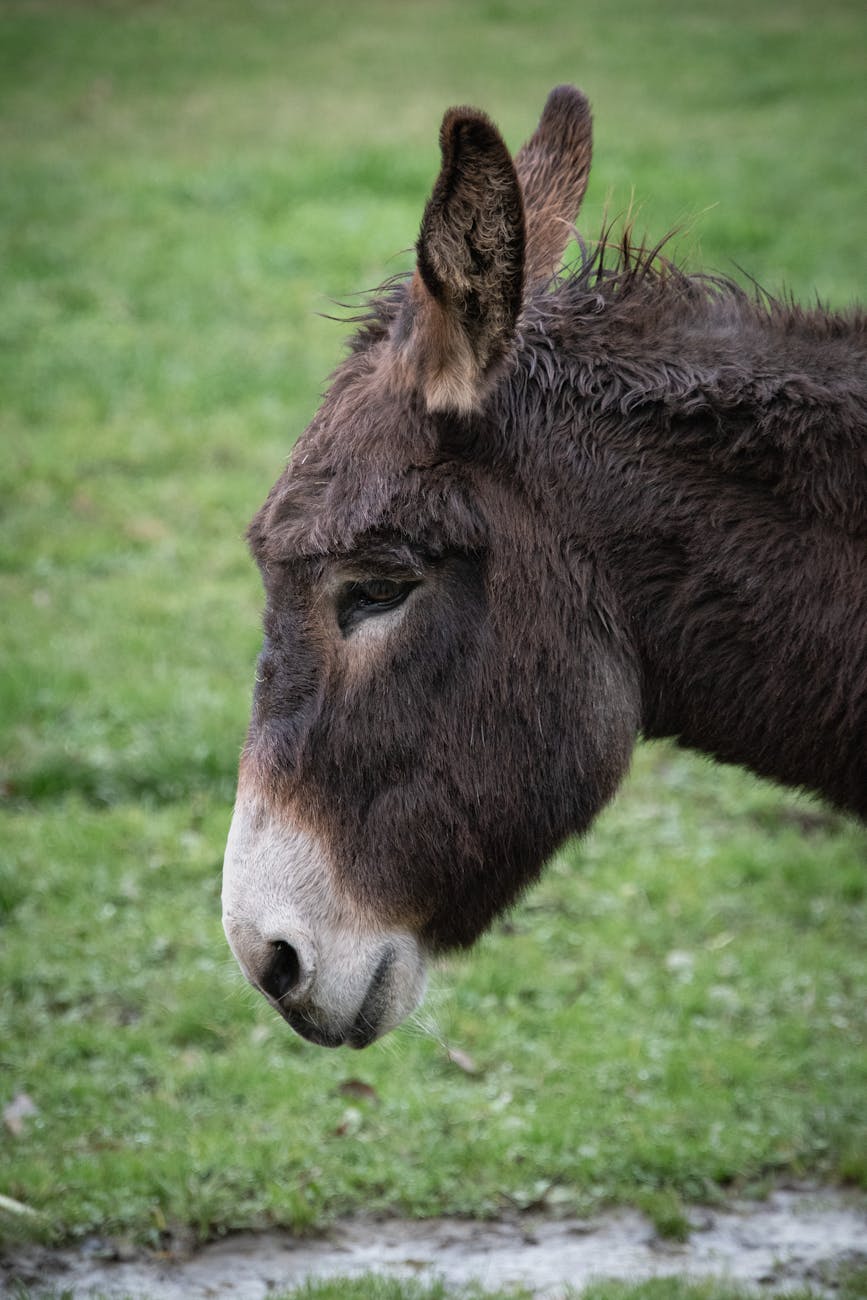
The spinster Graziella fell in love with her father Edgardo’s donkey, Corrado. A widower in his dotage, his cognition diminished if not impaired, Edgardo—who misidentified Corrado as a work hand on their farm—consented to the union with zero objections. Perhaps he figured it was time Graziella moved on with her life, no matter what the circumstances.
Upon catching wind of the impending nuptials, people in the village expressed horror. “How can she marry a donkey?” became a common refrain. Gossip hummed through the village streets, hearths, and dens. It was a sin. A crime. An abomination. But it was not unprecedented. A number of unions between humans and farm animals had been recorded in the annals of the village, but none in recent memory. Many villagers were invited; many vowed not to attend the ceremony and reception—to be held outdoors in a parco of all places, and presided over by the rogue minister, Padre Giacchino.
“How can she marry a donkey, Edgardo?” asked Zia Teresa, Graziella’s aunty, who upon hearing the news immediately rushed over from her cottage on the other side of the village where she lived with seven cats and a hideous possum she had named Bello.
Edgardo responded: “There is no need to get worked up or trouble your soul about things you can’t control. These things do not beg your judgment. Leave them be. My daughter will not live ten thousand years. Death hangs over her as it hangs over all of us.”
Her father’s eloquence and clarity, missing from his persona for moths if not years astonished Graziella. She viewed this as a positive sign; her father clearly understood she was marrying Corrado, his donkey, or at least she assumed he did. Indeed, despite his muddled mind, he had philosophically resigned himself to the union, and in his way had given it his blessing.
“Well, I think she is making a grand mistake,” said Zia Teresa. “How will he provide for her? How will he provide for you, my niece?”
Graziella reddened. “Corrado is a beast of burden,” she said. “He works hard, is loyal, and very intelligent. Moreover, he is compassionate, a trait sorely lacking these days.”
Zia Teresa tilted her head left then right and kept it there. “That’s all well and good, Graziella. But what about hygiene? Is he not filthy? Is he not a filthy animal?”
“He’s not filthy!” Edgardo interjected. “Sorry for shouting, but he is the picture of cleanliness.”
Limply waving her hands, Zia Teresa scoffed at her brother. What more could she say? The object of life is not to have everyone agree with you, but to resist joining the ranks of the insane. Her appeals to reason proved fruitless. The marriage would take place and no one could stop it.
The day arrived: a soaring blue and cloudless sky, the sun promising to shine but not too harshly. Ruffino and Garzo, the wedding planners hired for the event, had adorned the designated outdoor space—already lush with thick green grass, sweetbay magnolias and trembling aspens—with a profusion of garlands, bouquets and ribbons. Musician wrens, song sparrows, morning doves and honeybees lyrically supplied the summer sound effects.
Despite the beautiful preparations, few villagers showed, exhibiting the rigidity and pettiness so often attributed, whether incorrectly or not, to people from small communities. Of course Graziella’s father was there, stuffed into the black gabardine suit he had worn for his own wedding, more than three decades ago. Zia Teresa came dressed in navy blue silk with her face veiled as if in profound mourning or simple concealment. Cesario the baker—who had baked the towering wedding cake—was there with his hunchbacked but comely wife Philomena, who wore a green velvet dress that flattered her figure.
Also there were the diminutive brothers Ignazio and Giovanni, who had worked Edgardo’s farm and came dressed in ill-fitting dark wool suits that absorbed the sun and caused them to perspire heavily. Graziella’s childhood friend Silvana arrived in the arm of a devilish-looking man with jet-black hair and a thin goatee, wearing a tight-fitting, raspberry suit of clothes. Silvana, who had lost her right eye as a child to her father’s hunting falcon, long since dead, wore a blue satin gown with a matching eyepatch. Corrado’s good friend, the goat Gianfranco, from a neighbouring farm, arrived wearing a smart red-and-black polka dot bandana.
Meanwhile Corrado had been decked out with black and white silks, his hooves buffed and veneered, his tail brushed and oiled, his teeth flossed and polished, and all of him spritzed with rosewater and bergamot tincture. No one could deny he looked and smelled fabulous. Say what you will, for most of her life Graziella may have missed the mark with men, but it appeared she had stumbled upon a keeper with the donkey Corrado.
Edgardo had hired a fiddler and a flautist for the wedding march and for the reception. The fiddler wore green leggings and a green baize monkey jacket. The flautist wore a vintage tuxedo once black but now faded to grey. They played happy ditties and would have likely benefitted from a percussionist of some kind, even a tambourinist, but no one complained.
Graziella’s appearance drew audible gasps from the guests: her dress looked as though it had been modeled after the wedding cake—or vice versa—a tower of fluffy white folds, creamy layers and ornate piping, culminating in a velvety crown of scarlet blooms. She looked at once beautiful and preposterous. Corrado could not help but bray when he saw Graziella walk down the makeshift aisle with her father to the wooden platform where he and Padre Giacchino—wearing a black tunic and a conical black hat—stood waiting for her.
Edgardo burst into tears as he gave away his daughter, and one could not be certain if he wept from joy or from frustration with his failure to understand what exactly was taking place. Why was Corrado decked out in that manner? Should he not have been on the farm?
The ceremony proceeded apace. Vows were solemnly exchanged. Graziella embraced Corrado, who brayed with joy. No one objected. Edgardo wept. Graziella’s friend Silvana dabbed tears from her eyes as her consort caressed her hunch. Even Zia Teresa raised a kerchief under her veil to wipe away eye water. Whatever one’s philosophical or moral stance on these unions, one could not deny the beauty and grace of this ceremony.
The reception followed immediately. The guests were served wine and a variety of vittles, from roasted quails and leg of mutton to poached lobsters and raw oysters on the half-shell. The sweet table, brimming with tortes and cakes and pastries, put smiles on every face. Even Edgardo stopped blubbering as he heaped creamy sweets on a plate and gorged himself.
Ignazio and Giovani, the former work hands, sweating voluminously, drank too much wine and spent the better part of the afternoon with their hands on their knees, retching behind the trembling aspens. Meanwhile the musical duo played tune after tune. Silvana and her partner danced, and he showed immeasurable patience with her attempts to follow his lead for it was clear that she possessed two left feet. One can never judge by appearances alone. Similarly, the baker Cesario displayed incredible tolerance with his wife Philomena, who insisted on dancing despite her physical anomalies. Indeed, with Cesario’s steady and assiduous guidance, she danced quite well, bobbing her hunch rhythmically or rather contrapuntally to her husband’s rhythm, and taking care not to make hideous faces, for her movements looked painful.
Everyone ate, drank, and danced their fill. Gianfranco the goat and Corrado spent a few touching moments butting heads and scuffling as they once did as adolescents, braying and bleating merrily. Onlookers thought it lovely to see two chums enjoying each others company with such affection and abandon. Any censorious onlookers spying from a distance would be hard-pressed to condemn or deride the event, given its lilting and joyous airs.
Meanwhile, Graziella, in her towering gown, stood near a tree with fuchsia bark that she did not recognize. Had someone painted it? Tempted to touch it, she refrained, fearing it might give her painful eruptions in the manner of poison ivy or stinging nettle. Nevertheless she admired it. Fuchsia was one of her favourite colours. She turned her attention to the festivities and smiled. Lovely to see everyone enjoying themselves, she thought. But something dark and heavy had cast its shadow over her felicity. She glanced at Corrado, so handsomely attired. Then in a lightning bolt of sudden and horrifying clarity, it struck her that she had just married a donkey.
Sicilian Canadian poet and storyteller Salvatore Difalco writes from Toronto, Canada. Recent work appears in Cafe Irreal, E-ratio, and Sortes.